San Francisco
The Crying of Lot 49San Francisco becomes the testing ground for Oedipa Maas’s investigation of the Tristero: a city where she hopes distance from Pierce Inverarity’s estate might make the mystery dissolve, but where signs, encounters, and postal routes instead gather into a denser pattern. Its freeway, nightlife, streets, and mail carriers offer tangible evidence while leaving open whether the network exists independently or is being imposed on events by Oedipa’s interpretation.
Setting and First Test
After fleeing John Nefastis’s home, Oedipa drives without much conscious direction and finds herself on the freeway toward the Bay Bridge. The rush-hour traffic surprises her; looking down toward the city from the bridge, she first identifies smog and then corrects herself to haze, measuring what she sees against the popular belief that such conditions belong farther south. The scene places her in a familiar urban landscape that nevertheless resists the categories she brings to it.
On the bridge and amid the traffic, Oedipa returns to the problem of the Tristero. She knows of its European opposition to the Thurn and Taxis postal system, its muted post horn, its alleged arrival in America before 1853, and its possible survival as an alternative means of communication in California. These reported connections also reach into the present: she wonders whether her husband, Mucho Maas, might have used the network, though she has discarded the letter that could have helped Genghis Cohen check its stamp.
San Francisco is meant to give her a way out of the estate’s influence. Away from its tangible assets, she reasons, she might watch nothing happen and conclude that the Tristero is only nervousness or fantasy. She leaves the freeway at North Beach, parks among warehouses, and walks into the evening crowd. The experiment is deliberately simple—drift at random and see whether the signs stop appearing—but within an hour she sees another muted post horn.
A Night of Repeated Signs
The first encounter comes amid a rowdy group of guided tourists. A man identified as Arnold Snarb pins a conspicuous name badge on Oedipa and disappears into the crowd; someone then directs the badged group toward The Greek Way. She initially resists being swept along, but recalls her decision to drift and goes with the crowd. The episode places the post-horn search inside the city’s nightlife, where chance meetings and organized movement are difficult to distinguish.
After leaving the bar, Oedipa spends the rest of the night looking for the emblem. In Chinatown, she thinks she sees it on a sign in a herbalist’s window, though the light is too dim to be sure. Later, she finds two chalk post horns about twenty feet apart, with a complicated arrangement of boxes, letters, and numbers between them. She copies the diagram into her memo book, unable to decide whether it is a children’s game, a map, or a record of secret history.
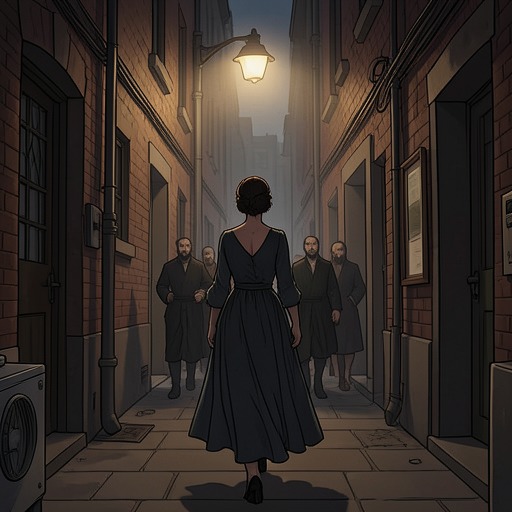
A figure in a black suit watches her from a doorway half a block away. Oedipa thinks the collar may be turned around and leaves rather than risk approaching; she runs for a bus and thereafter uses buses, sometimes getting off to walk so she can stay awake. The night’s symbols enter her dreams as well. By morning, she recognizes that she may later have trouble separating what happened from what she dreamed, so the city’s accumulating clues are accompanied by uncertainty about the reliability of her own recollection.
The Underground Mail Route
The investigation later brings Oedipa beneath the freeway, where she searches among the city’s concrete supports for a secret mailbox. After witnessing the burning of a sailor’s mattress, she reflects on how much of a person’s history can disappear without leaving a trace. She then finds an old green trash can, nearly four feet high, with a swinging trapezoidal lid and the initials W.A.S.T.E. painted on it. The ordinary refuse container serves as a concealed point of entry into a mail system she has been trying to locate.
Oedipa sees a child drop a bundle of letters into the can and adds the sailor’s letter to Fresno. She hides and waits. Near midday, a young carrier arrives with a sack, unlocks a side panel, and removes the letters. Oedipa follows him from the box; near City Hall, he meets another carrier and exchanges sacks. She continues after the first man through Market Street to the transbay bus terminal, takes the same Oakland-bound trip, and follows him through Oakland and onto a Berkeley bus. The route leads her back to the area where Nefastis lives, bringing her around to where she began rather than to an independent confirmation of the network.
This pursuit gives W.A.S.T.E. a concrete operation: letters are deposited, collected, transferred between carriers, and carried across the Bay. But the circular ending complicates what the journey proves. Oedipa has followed a functioning chain of delivery, yet its return to a familiar starting point does not establish who controls it or how it relates to the Tristero.
City, Estate, and Uncertainty
The evidence in San Francisco repeatedly approaches the Tristero through material traces: a post horn, a chalk diagram, a hidden mailbox, and carriers exchanging sacks. Elsewhere, a watermark on a stamp inspected by Cohen shows Oedipa’s WASTE symbol, strengthening the apparent connection between the signs and postal activity. Together, these clues make the city seem less like a random backdrop than a communications network whose separate points might connect.
That interpretation is unsettled when Oedipa returns to San Narciso and discovers how many apparent routes to the Tristero lead back to Inverarity’s property and associates. She considers whether the people and places involved might be connected to Pierce, perhaps as participants in an elaborate practical joke, or whether the network is genuine and offers an alternative to the official mail system. San Francisco had seemed like a place outside the estate’s tangible reach; the later discovery that every access route might circle back to it weakens that hoped-for separation.
The city’s significance therefore lies in the difference between following a route and knowing what it means. Oedipa can observe signs, copy a diagram, and follow a mail carrier across municipal and regional space. She cannot securely determine whether these observations disclose an independent clandestine system, a construction shaped by the estate, or a pattern emerging from her own uncertainty. San Francisco makes the Tristero materially plausible without making it conclusive.